
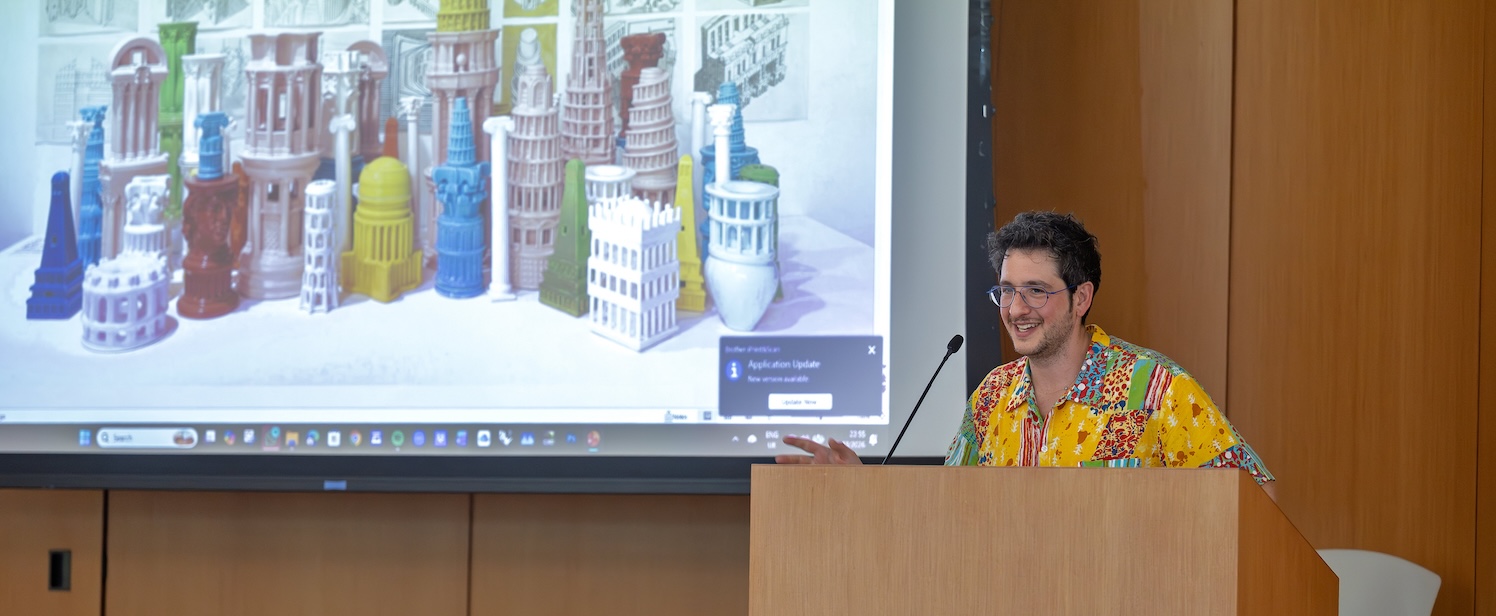
Adorned in bright colors and eye-catching patterns, Adam Nathaniel Furman, a London-based artist and designer, took the stage at The John Elliot Center for Architecture and Environmental Design’s Cene Lecture Hall to deliver “Productive Exuberance,� a lecture spanning his creative career.
Eager students, staff and faculty gathered in the hall to hear Furman’s story and see his work on display.
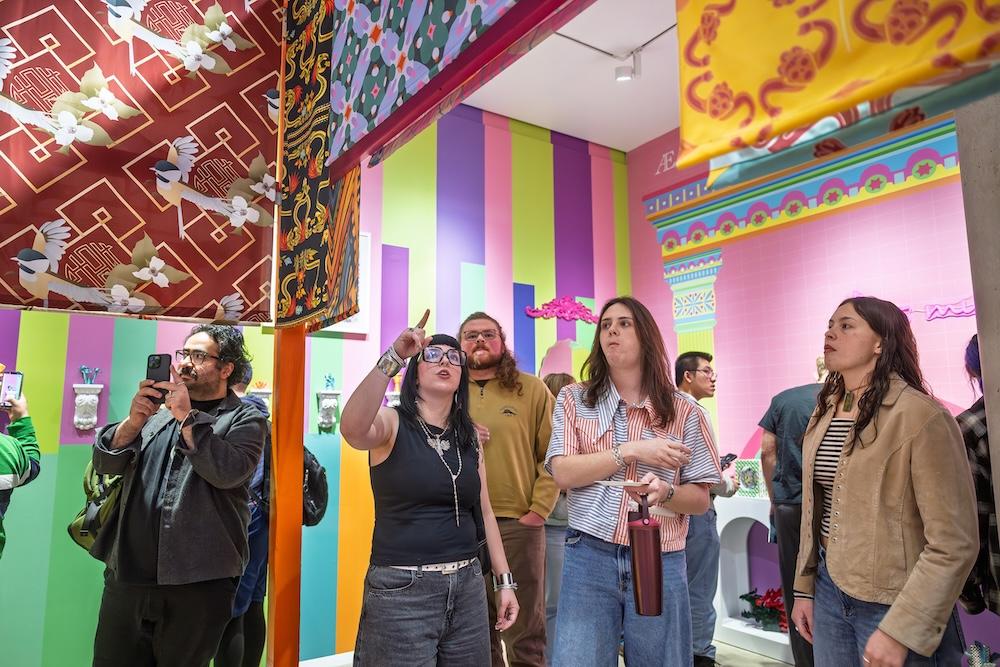
Furman’s multidisciplinary practice spans architecture, interiors, public art and ceramics, blending historical references with contemporary culture to create immersive, visually dynamic spaces. Furman has exhibited widely at some of the world’s most respected cultural institutions and design events. His work has been shown at the Design Museum in London, Sir John Soane’s Museum in London and the Carnegie Museum of Art in Pittsburgh.
Internationally, he has exhibited during Milan Design Week and at major design biennials and festivals. Furman has been recognized for projects that challenge minimalist conventions while celebrating craftsmanship and materiality. In addition to his design work, he is an educator and writer, contributing to conversations around architecture, identity and the decorative arts.
Furman spoke as part of 17cÍøÒ³°æ’s 2025-2026 Thomas Schroth Visiting Artist Series that highlights guest artists respected in the field of theatre, dance, visual arts, music and architecture.
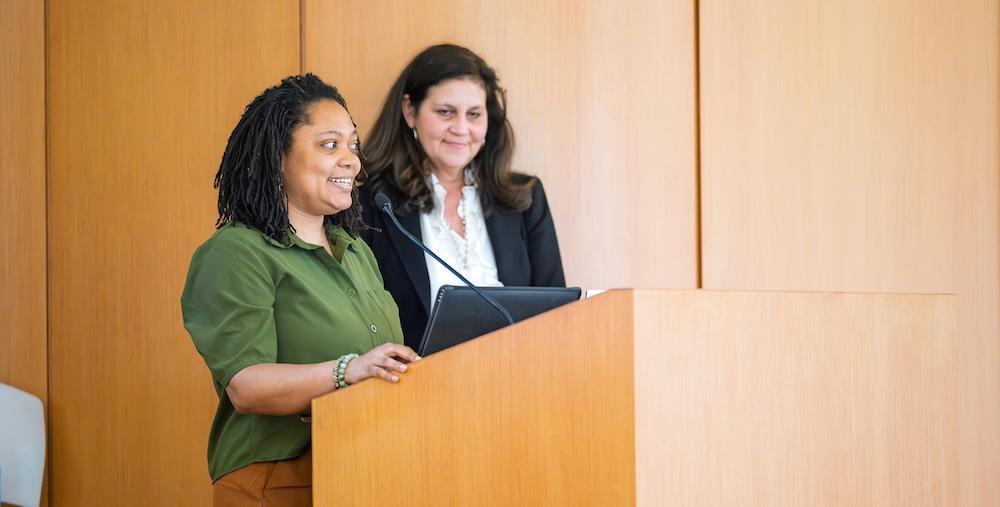
Furman collaborated with Kristen Mimms Scavnicky, assistant professor of architecture, and Sue Hershberger Yoder, professor of fashion design and merchandising, to lead a design workshop. The workshop will be used to create a large-scale gateway installation for the 17cÍøÒ³°æ School of Fashion’s 2026 Fashion Week.
Scavnicky took the stage at Cene Lecture Hall to introduce Furman and shared with audience members how they built a connection.
Scavnicky got to know Furman over a 14-month span of time, initially reaching out to Furman via social media. Their connection blossomed from there.
“I was really happy to know that [Furman] is just as warm and friendly as his vibrant work,� Scavnicky told the crowd.
As students listened, Furman explained the context surrounding his upbringing and its effect on his work.
Furman’s work is deeply affected by his childhood and experiences in London. He was directly affected by Section 28, the act “prohibited promoting homosexuality by teaching or by publishing material.� Furman, as a young, openly gay student, was asked to leave his school.
After being asked to leave school, Furman discovered his first queer space, the first place he felt welcome. From there, he was introduced to a new world.
"It was a vibrant world that was aesthetically expressing its own identity through visual culture,� Furman said. “The world is this incredible sea of meaningful objects that are constantly changing place.�
Furman told the crowd he approaches design with the intention of creating objects with personality, as if they have tiny stories or meanings.
That philosophy resonated; students, faculty and staff alike were drawn to his vivid designs.
“His work reminds us that design is never just about function,� Scavnicky said. “It’s also about atmosphere, it’s about feeling, symbolism and the stories that surfaces carry within them.�
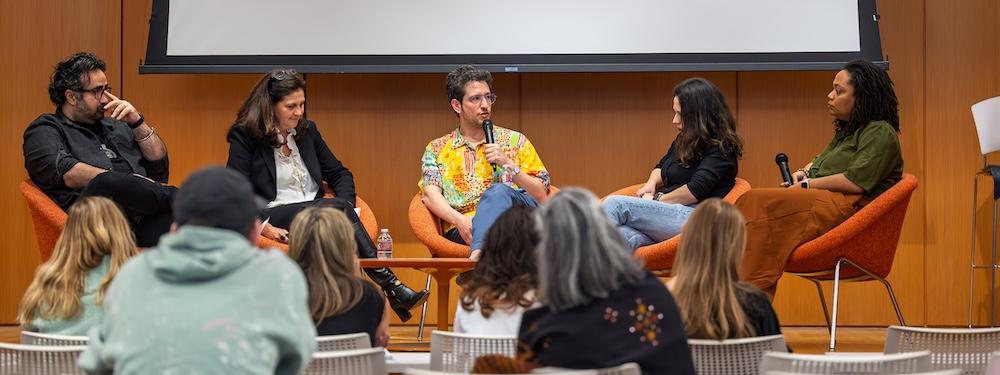
After Furman presented “Productive Exuberance,� Furman, Scavnicky and Yoder participated in an engaging conversation alongside Ebrahim Poustinchi, associate professor of architecture, and Andrea Sosa Fontaine, assistant professor of interior design.
The evening concluded with the exhibition opening and reception outside the Armstrong Gallery.
To view Furman’s work, visit the Armstrong Gallery in The John Elliot Center for Architecture and Environmental Design. The exhibition will remain on public display until June 26 and will be temporarily relocated from April 27-May 2 to be incorporated into the 17cÍøÒ³°æ School of Fashion’s annual Fashion Week events.
The Schroth series was established by Cecile Draime and her late husband, Max, of Warren, Ohio, to honor their dear friend Thomas Schroth (1922-1997). A noted regional architect, Schroth designed the Butler Institute of Art’s Trumbull Museum in Howland, Ohio, as well as numerous other award-winning projects. Schroth spent his life in Niles, Ohio, as a prominent architect and inveterate collaborator in the artistic life of the Mahoning Valley and Northeast Ohio. A world traveler, he saw human creativity as a window framing human experience. The Thomas Schroth Visiting Artist Series brings diverse views through that window to the Kent Campus and the university community.
The Thomas Schroth Visiting Artist Series is presented jointly by 17cÍøÒ³°æ’s College of Architecture and Environmental Design and the College of the Arts. The events are always free and open to the public.
Learn more about the Thomas Schroth Visiting Artist Series here.